Harvey's Garage Door
(760) 636-6174
FREE ESTIMATES & SAME DAY SERVICE!

Serving The Coachella Valley Since 1972
Quality Service - Sales - Installation
DESERT'S EXPERT GUIDE TO GARAGE DOOR SPRINGS
Compact insightful information on garage door spring repair, installation, and maintenance
About Garage Door Springs
Garage door springs, often called 'garage springs' are rarely given credit for the work they do. For perspective, if your garage door ecosystem and its several diverse (mechanical and digital) components was a body, the springs would be the most important muscle group! It is crucial to understand both for safety and education that your garage door is far heavier than many realize, easily weighing hundreds of pounds. The reason it might feel 'light' when you manually lift your garage door is because functional springs alleviate roughly 95% of the garage door's total weight. This is necessary because while garage door openers are efficient, they're actually deceptively weak: The average household garage door motor only exerts half a horsepower of pulling force. Meaning your garage door opener absolutely can not move your garage door on its own, and even attempting to do so would result in severe damage to the motor. This is why when torsion springs are sufficiently damaged or reach the end of their cycle life, your garage door becomes an immovable entrapping wall if it is in the down position, and a weighty hazardous guillotine if it is in the upward position. It isn't just business speak when companies like us recommend contacting a professional for spring damage, your garage door springs are simply that important! That's why here on our website, the experienced local technicians at Harvey's Garage Door have devoted this entire webpage to educating homeowners to become familiar to one of the most crucial parts of the garage: Garage door springs.
Repairing Garage Door Springs
Safety warnings: it is important to follow good practices by being informed of the serious potential dangers involved in handling garage door springs. Garage door springs hold anywhere from one hundred to three hundred and fifty pounds of coiled tension force (while your garage door is in the closed position). For comparison it only requires twenty to fifty pounds of tension force to dislocate a human finger. Potential for bodily harm is increased if grip is lost on tensioning tools during the tuning process, as any objects firmly inserted into the springs will serve as reach extensions of the spring's tension force. That means torsion bars can rebound to inflict blunt force in the event of slippage. Attempting to fix garage door springs with a shoulder impairment is unadvised, as that is the primary muscle used throughout the process, and sudden failure as discussed, can potentially lead to serious bodily harm.
Key Considerations: Whenever our technicians are working on torsion springs, the first thing we do is ensure the garage door is safely set into the down position. This is because despite appearances, the track is not designed to hold the entire weight of a garage door unassisted. Additionally, the torsion bars used to torsion the springs are often obstructed by the garage door. If the door is jammed in the upward position, it is often a cable issue that will need to be handled before work can begin on the springs. Regardless, once work begins on the springs, it is perhaps even more critical to properly calculate the spring coil size against their overall length to determine the strength rating of your springs. The force exerted is then to be balanced against the weight of your door. In the industry, some companies such as ours will go so far as to painstakingly manually categorize each spring received from the factory, labelling them in sizes one-through-twelve based on their support capability. Size one, generally being our weakest, and size twelve generally being our largest heavy-duty springs. On this scale, springs 2-4 are most common for residential purposes.
Why it matters: Without springs properly balanced to the weight of your door, you will face varying degrees of two extremes. In scenario one, your springs will be too powerful, holding your garage door either partially, or fully open. In scenario two your springs will be too weak for the weight of your garage door, and your motor will either struggle to open the garage door, or will be unable to entirely. While the unique obstacles presented vary, both scenarios lead to a damaged or broken garage door motor. This is because as alluded to earlier in this consumer's guide, residential garage door motors are too weak to lift your garage door unassisted, and that means attempts to do so will damage your motor. Which is a thorough way of simply communicating this solid piece of advice: 'if your springs are broken, don't try to open your garage door, you'll break your motor'.
How it's done: After all other crucial safety and critical diagnostic steps are completed, we finally pull out the tools and get to work. The most common tool for the process, aside from the specialized scales to assist with calculations, are the spring torsion bars. Humble, relatively thick, unassuming metal bars used to adjust the tension in torsion springs. These bars are inserted inside the outward facing holes on the spring cap, and carefully turned to loosen or tighten the spring. For most residential garage doors, the sweet spot with a standard pair of torsion springs is an average of around 200 inch pounds per turn. Though, there are many other factors besides tightness to account for in overall spring weight, such as tube diameter and spring wire diameter. Generally however, tightness is the most important. It is also crucial to note that while spring torsion bars are iconic, technology has come a long way, and many professionals including those at Harvey's Garage Door sometimes deploy complex specialized tools used to make the process significantly safer, and more efficient.

(Above) Two technicians preparing to install a second spring.

(Above) A broken spring. Notice how the coils separate, exposing the bar.
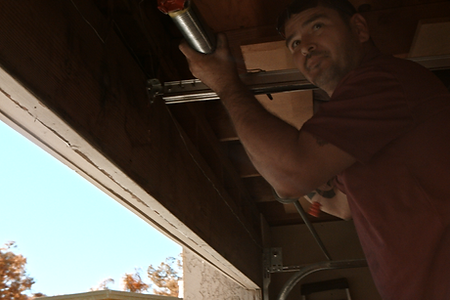
(Above) A Harvey's technician installing a pair of new springs.
Contacting Us
"The Harvey's Experience" is about services of a superior quality, completed at your schedule. That's why we offer same day service & free estimates to all our customers. We're confident that our products are a step above the competition, and invite you to reach out through one of the contact methods below and speak to one of our experts, whether online, over the phone, or in person to experience it yourself.
Phone: (760)-636-6174
Email: Harveysdoorco@gmail.com
Address: 74831 Velie Way #5, Palm Desert, CA
No matter which method of contact you choose, we'd love to hear from you! As a company operating locally in the desert valley since 1972, our business model has always been satisfied customers. Harvey's has thrived for over 50 years as the trusted vendor for numerous HOAs, and countless customers who have experienced the Harvey's difference. When you call Harvey's, you're in good hands!
(Below) Harvey, the company's founder.

The Spring Repair Process
Our spring repair and install methods may vary, and our technicians are permitted to change the process in order to further benefit the customer. All variations conform to HOA standards.
- Step one: Check the springs. If the job is a repair, then it is always a good idea to check if the springs actually need to be repaired. If everything checks out, a maintenance might be recommended instead, in order to prevent any issues in the future.
- Step two: Put the garage door in the down position. This prevents the garage door from crashing down while the repair is taking place. This step is crucial.
- Step three: Calibrate the old springs & the cable drum. Making certain that everything is in working order and properly positioned is vital to achieving optimal efficiency.
- Step four: Tighten the springs. Spring tension is weighed and the old springs are tightened with special tools to allow proper function.
- Step five: Lubricate the springs. Now that the springs are properly tightened and aligned, our technicians will lubricate them with our special time tested lubricant in order to make sure they work as intended for years to come.
- Step six: Clean up. Now that the job is done, we make sure to pack up our tools and sweep the floor just for good measure.
Spring Installation Process
Our spring installation methods may vary depending on the job at hand, and our technicians are permitted to change the process in order to further benefit the customer. All variations conform to HOA standards.
- Step one: Prepare. It is important to make sure that all the proper materials for the job are at your disposal. This includes the proper tools, and the correct replacement springs.
- Step two: Put the garage door in the down position. This prevents the garage door from crashing down while the repair/install is taking place. This step is crucial.
- Step three: Remove the old pair. For first time customers, the difference between a durable pair of Harvey's springs and the more fragile springs of our competitors is immediately noticeable. The garage door is prepared for the swap, and the springs are removed from their bars. If the springs are broken, they are recycled in our metal bin to better the environment.
- Step four: Install the new pair of Harvey's signature durability springs. A new pair is quickly fixed onto the bar in place of the old springs. This must be done quickly in prioritization of safety.
- Step five: Tighten the new springs. After the new springs are in place, they are tightened with special tools, in order for them to perform at peak efficiency.
- Step six: Lubricate the springs. Now that Bthe new pair of springs are properly tightened, our technicians will lubricate them with our special time tested lubricant in order to make sure they work as intended for years to come.
- Step Seven: Clean up. Now that the job is done, we make sure to pack up our tools, recycle the old pair of springs, and sweep the floor. In order to give your garage a fresh look.

(Below) One of our long time customers who knew Harvey.

Maintenance Services
Sometimes, a repair isn't necessary. In these cases cases, a customer usually hears their garage door loudly screeching as it goes up, or making popping sounds as it moves downward. This could just mean your springs need to be properly tightened and lubricated. In such a case, our employees will downgrade your repair order to a much cheaper solution: maintenance.
Almost all garage door issues can be prevented with proper maintenance. What we do during our maintenance services ranges from tightening bolts, to springs. It includes things such as lubricating your garage door and its springs. These maintenance services are usually done once every year, and we offer a discount to customers who call us in for annual maintenance.

Speak with a professional today,
(760)-636-6174
FREE OF CHARGE!